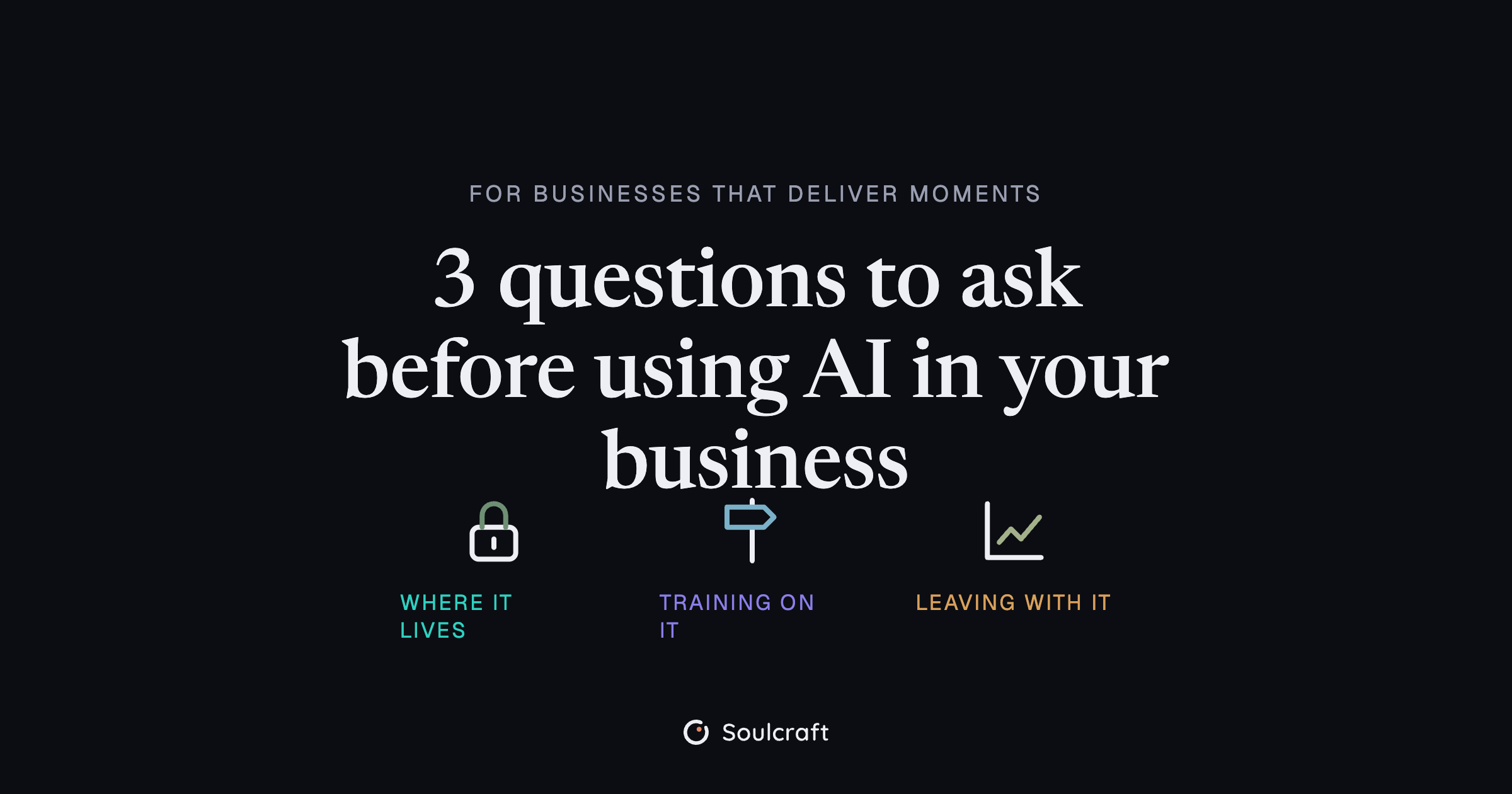
You don't need to be technical. You just need to be informed — ask three questions out loud, and understand why each one matters for your business.
When you sign up for an AI tool — a booking assistant, a review responder, a marketing helper — your business goes with it: your customer list, your notes, your prices, your way of doing things. Three questions, asked before you sign, tell you almost everything you need to know about the company on the other side.

Where does my customers' information actually live?
Not "is it secure." Everyone says yes to that.
A good answer
"On our servers in Virginia. Your data is in its own space. Three engineers have access, and every time they look, it's logged."
A not-answer
"It's all cloud-based, enterprise-grade, fully encrypted."
The second one isn't a lie. It's just not an answer. A vendor who knows their own product can name the place, the boundary around your data, and who holds a key.
Why it matters: your customers didn't give their phone number to a software company. They gave it to you. Everywhere it goes after that, it goes because you sent it — and if it's ever mishandled, yours is the name your customers know. Asking this question is how you stay able to look them in the eyes and say you know exactly where their information is and how it's being handled.

Are you training on my data?
Many tools — especially the free ones — learn from whatever gets typed into them.
A good answer
"No. Never used for training. It's section four — here, I'll show you the sentence."
Worth a follow-up
"We may use aggregated, anonymized data to improve the service."
A good answer is a plain no — with the sentence in the contract to prove it. "Aggregated and anonymized" might be fine, but ask them to explain it with an example. And if it's a free tool with no answer at all, assume the answer is yes: the tool is free because the information isn't.
Why it matters: sometimes what's in your data is your proprietary secret sauce — the recipes, the routes, the treatment sequences, the way you win a regular back. It should stay that way. Not used to help train the AI for your competitors.

If I leave in a year, do I take my data with me?
This decides whether you've got a vendor or a landlord.
A good answer
"Export button in settings. Standard spreadsheet. Anytime. No charge."
A red flag
"We'd work with you on a migration plan."
That's not a plan. That's a negotiation tactic when you are most stressed — mid-switch, mid-season, with your customer history on the other side of the table. A good answer needs no meeting.
Why it matters: you and your customers should have the right to move safely and freely, at any time — without any disruptions to your business. Tools will come and go; your customer history should move when you do.
How to ask all three
You don't even have to ask in person. Send a short email before any demo:
Subject: 3 quick questions about your apps, tools and AI
Before we talk, three quick ones:
1. Where is our customer data stored?
2. Is it used to train your models?
3. If we leave, can we export everything?
Thanks.
Ask before you use AI apps for your business. You'll learn a lot from how long the reply takes. And remember: a vague answer is an answer.
Always ask — because protecting your customer's trust matters.
The bigger picture, briefly
This isn't really about protecting yourself from bad vendors, though it does that.
It's that right now, an enormous amount of ordinary human information — who's sick, who's behind on payments, who's going through a divorce, who called crying — is quietly moving from the small businesses that earned it into systems nobody asked about. Not through malice. Through twenty-minute demos and a number that seemed reasonable.
Every owner who asks these three questions makes that a little less automatic. Vendors notice when customers ask. It changes what gets built.
And on the small scale: you become the shop that can look a customer in the eye and say I know exactly where your information is, and nobody's selling it. Almost nobody can say that sentence right now.
Three questions. Fifteen minutes. Do it before the next demo.
This is a public service post for small businesses, from the team at Soulcraft. No product in it. If it was useful, that's the whole point.
Want to check out our AI Promise? https://soulcraft.com/promise
Interested in learning more about our pricing comparisons for businesses? https://soulcraft.com/math